13, avenue du Président Wilson 75116 Paris
Open
12h - 21h
Eco Mode
SEARCH THE ENTIRE SITE
Popular searches :
See below
View of the exhibition “Utopia utopia”, presented by the Palais de Tokyo at the Espace Niemeyer, Paris, 2026. Credit: Antoine Aphesbero
Utopia Utopia
Babi Badalovfrom 07/04/2026 to 09/20/2026
[OFF SITE] At Espace Niemeyer, headquarters of the French Communist Party
In Babi Badalov’s sensitive and remarkably prolific body of work, words create forms creating sense. A visual poetry unfolds across a wide range of media —textile, collage, drawings on administrative documents—oscillating between art brut, classicism, baroque and punk aesthetics. His obsessive calligraphy plays with the plasticity of language through wordplay, repetition and homophony, as well as elongation of letters that drift toward arabesque. While his practice bears affinities with graffiti, it remainsdeeply marked by ornamentation, revealing the connections between drawing and writing embedded within the Islamic tradition, from which the artist partly originates. Working with recycled materials and embracing an aesthetic of urgency, Badalov’s craftsmanship displays a rich allure despite the modesty of its means.

Through his singular lens, fragments of history emerge, from the collapse of the Soviet Union to the COVID pandemic, from Joseph Beuys to Bakunin. Babi Badalov has lived through this history, beginning in his native Azerbaijan and continuing through successive periods of emigration to the United States, Turkey, the United Kingdom, and finally France, where he was granted political refugee status in 2011. Where language can become a barrier, Babi Badalov combines it with imagery and reappropriates it to transform it into a mode of relation and exchange.
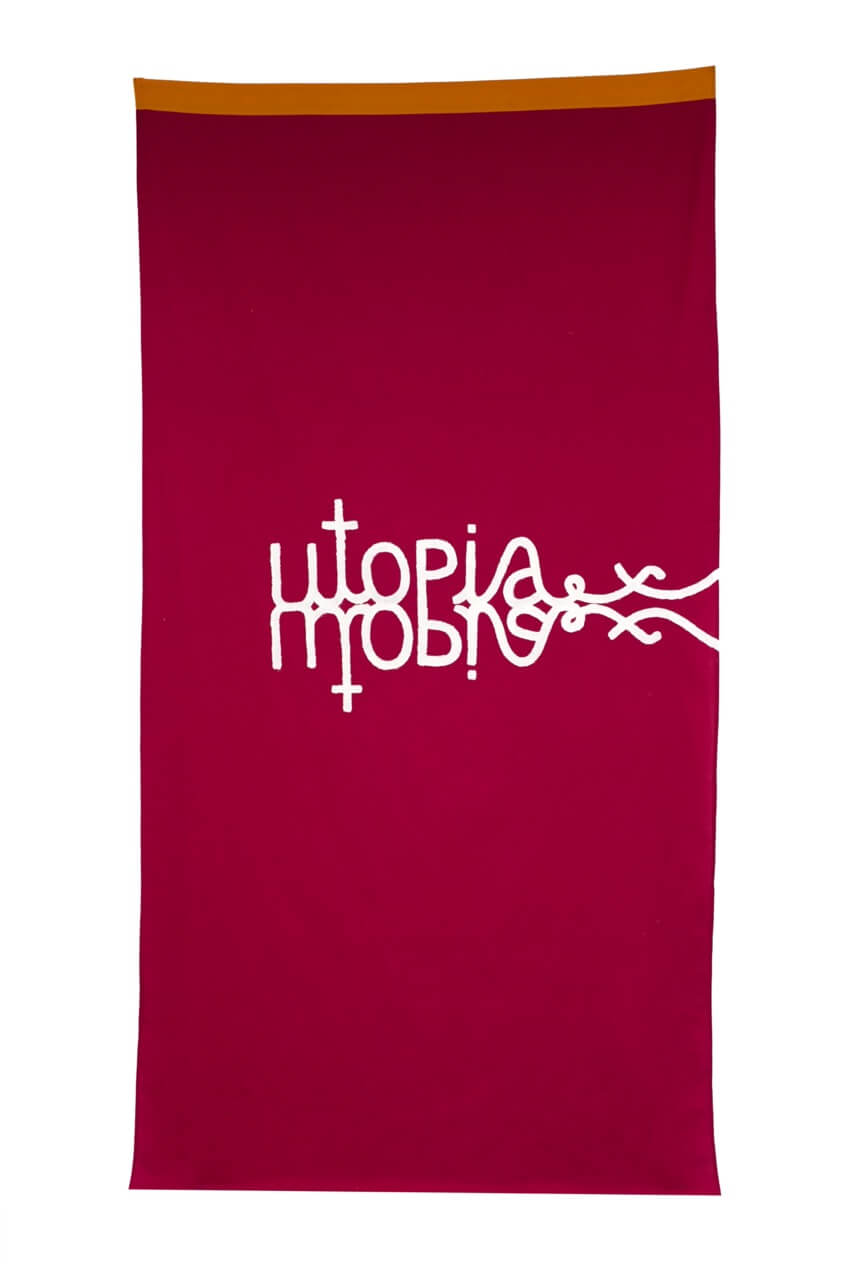


For Babi Badalov, words constitute a way of being in the world. They evoke his lived reality and the political issues that run through it : cultural hybridity, human rights, globalization, exile, identity, freedom of expression and the consequences of capitalism. Language is, by nature, a normative system. In Babi Badalov’s work, this norm degenerates, derails, and runs wild in every direction. Such liberation comes at the risk of mystery, but also of absurdity and of foolishness, which, as we know, can be another form of wisdom.
At Espace Niemeyer – headquarters of the French Communist Party, Babi Badalov’s poetic slogans, capable of bringing about alternative realities, resonate particularly strongly with the spirit of the place. A historic site, imbued with great ideals. A place where mottos such as “Utopians, rise up!” or “General dream!” have echoed. Reimagining the slogan through his voice —at once marginal, hybrid, and ambivalent—he proclaims a form of freedom that appeals to sensibility rather than reason. Babi Badalov reactivates the power of words and their ability to resonate, to bring people together, and to sketch out other possible worlds.

FROM 07/04/2026 TO 09/20/2026
Practical information
- Rates: the exhibition is free and open to all
- Opening hours: the exhibition is open from Tuesday to Saturday, 12 p.m. to 7 p.m.
- Access: Espace Niemeyer – headquarters of the French Communist Party, 2 place du Colonel Fabien, 75019 Paris
- Metro Colonel Fabien > Line 2 / Metro Jaurès > Line 5 / Bus > 46 and 75

A project by the Palais de Tokyo in collaboration with Espace Niemeyer – headquarters of the French Communist Party, Libres comme l’art, and Galerie Poggi.